
Brazil is one of the world’s major poultry-producing and exporting countries, making Brazilian frozen chicken products an important sourcing option for international wholesalers, importers, distributors, foodservice companies and processors. Difference Between Brazilian Chicken Feet and Chicken Paws
Among the most commercially interesting poultry products are frozen chicken feet and frozen chicken paws. These products are particularly relevant to Asian markets, including China, Hong Kong and South Korea, where chicken feet and related poultry products have established culinary and commercial demand.
One of the most frequently searched questions among international buyers is:
What is the difference between Brazilian chicken feet and chicken paws?
The terms “chicken feet” and “chicken paws” are sometimes used interchangeably in international poultry trading. However, product terminology can vary between suppliers, countries, processors and buyers. In wholesale transactions, it is therefore important to establish exactly what product is being offered, how it is processed, what specifications apply and how it will be packaged.
For buyers sourcing from Brazil, this distinction is especially important when requesting quotations, comparing suppliers and preparing import documentation.
Coopavel Cooperativa Agroindustrial is a Brazilian agricultural cooperative associated with the production and commercialization of agricultural products, including frozen poultry products for international markets. Buyers can explore the company’s poultry range through the Coopavel Cooperativa Agroindustrial website.
What Is the Difference Between Brazilian Chicken Feet and Chicken Paws?
The simplest answer is that chicken feet and chicken paws generally refer to the lower part of a chicken’s leg, but the exact commercial meaning can differ according to processing and market terminology.
A chicken’s lower limb consists of several anatomical sections. In poultry trading, “chicken feet” may be used as a broad term for the foot or lower-leg portion, while “chicken paws” is frequently used in international trade to describe the cleaned, processed foot product supplied for food markets.
However, there is no single worldwide terminology standard that makes “feet” and “paws” completely different products in every market.
This is why buyers should focus on the actual product specification, rather than relying exclusively on the name.
When purchasing Brazilian frozen chicken feet or paws, ask the supplier to specify:
- Exact product description
- Processing method
- Whether the product is skin-on
- Whether nails are removed
- Whether yellow skin is retained
- Whether the product is cleaned
- Weight range
- Grade
- Packaging
- Net weight per carton
- Cartons per pallet
- Freezing method
- Storage temperature
- Shelf life
- Country of origin
- Applicable export documentation
These details provide a much clearer basis for comparing products than the words “feet” or “paws” alone.
Why Brazilian Chicken Feet Are Popular With International Buyers
Chicken feet have traditionally been considered a valuable poultry product in a number of Asian markets.
While some Western markets have historically focused on breast meat, thighs and wings, chicken feet can command significant commercial interest in markets where they are used in traditional dishes, dim sum, soups, snacks and other food preparations.
This creates an opportunity for international importers to source chicken feet from major poultry-producing countries.
Brazil has several advantages as a poultry-sourcing origin:
- Large-scale poultry production
- Established agricultural infrastructure
- International export experience
- Modern processing facilities
- Cold-chain logistics
- Multiple poultry product categories
- Established ports and export routes
- Experience serving international markets
For importers, this means Brazil can be considered not only for chicken feet but also for a broader range of frozen poultry products.
Brazilian Frozen Chicken Feet for China Buyers
China is one of the most important markets to consider when discussing frozen chicken feet.
Chinese consumers have a long-established culinary interest in chicken feet, and the product can be used across restaurants, foodservice operations, wholesale markets and retail channels.
For Chinese importers, however, buying frozen chicken feet is not simply a question of finding the lowest price.
The importer should evaluate:
- Supplier reliability
- Product specifications
- Establishment eligibility
- Export documentation
- Import requirements
- Packaging
- Labeling
- Cold-chain logistics
- Port of arrival
- Customs procedures
- Total landed cost
A buyer should establish the exact product requirements before requesting a final quotation.
For example, one importer may want a particular grade of frozen chicken paws with specific weight and appearance requirements, while another may prioritize carton size and container utilization.
Frozen Chicken Feet for Hong Kong Buyers
Hong Kong is another important destination for poultry products and has a highly developed foodservice, wholesale and restaurant sector.
Hong Kong buyers may include:
- Poultry importers
- Restaurant suppliers
- Food distributors
- Wholesale traders
- Foodservice companies
- Retail distributors
- Processing companies
Because Hong Kong is a sophisticated food-import market, buyers should pay close attention to documentation, product labeling, sanitary requirements and cold-chain handling.
A Brazilian supplier should be able to clearly communicate the product specification and provide the commercial documentation necessary for the buyer to arrange import procedures.
For large orders, buyers should also consider whether the supplier can provide consistent specifications across multiple shipments.
Frozen Chicken Feet for South Korea Buyers
South Korea is another Asian market where poultry products can be commercially attractive.
South Korean importers may source different frozen poultry products for foodservice, manufacturing, wholesale distribution and retail.
For chicken feet specifically, buyers should establish:
- Product form
- Processing requirements
- Weight range
- Packaging
- Country of origin
- Production establishment
- Health documentation
- Import eligibility
- Cold-chain requirements
The supplier and Korean importer should confirm the applicable requirements before shipment.
This is especially important when dealing with large-volume container orders.
What Makes Brazilian Chicken Feet Different From Other Origins?
Brazilian chicken feet compete with products from several poultry-producing countries.
When comparing Brazilian products with chicken feet from other origins, buyers should not look only at the country name.
Instead, evaluate the entire supply chain.
Important comparison points include:
Product Quality
The physical appearance, cleanliness, processing and consistency of the product can influence its value.
Grade
Different buyers may require different grades depending on their target market.
Processing
Processing specifications can influence the final usability of the product.
Packaging
Carton weight and packaging configuration affect logistics and warehouse handling.
Supplier Capacity
A supplier must be able to maintain consistent quality when supplying repeated container orders.
Documentation
Proper export documentation is essential for international trade.
Logistics
Shipping time, port selection and cold-chain management influence landed cost and product condition.
How Are Chicken Feet and Chicken Paws Processed?
The exact process depends on the processing establishment and product specification.
Generally, poultry feet intended for international food markets undergo controlled processing and cleaning procedures before freezing and packaging.
Processing may involve steps such as:
- Collection from poultry processing
- Separation of the relevant poultry part
- Cleaning
- Removal of unwanted material
- Processing according to market specifications
- Inspection and quality control
- Freezing
- Packaging
- Storage
- Shipment under controlled conditions
The buyer should never assume that every supplier uses exactly the same process.
Instead, request a product specification sheet and confirm the processing requirements before purchasing.
Why Product Specifications Matter More Than Product Names
Suppose one Brazilian supplier advertises “frozen chicken feet” while another advertises “frozen chicken paws.”
The names alone do not necessarily tell you whether the two products are identical.
The products could differ in:
- Cleaning
- Nail removal
- Skin appearance
- Size
- Weight
- Grade
- Processing
- Packaging
- Freezing
- Intended market
This is why professional importers request technical specifications.
When requesting a quotation, instead of asking only:
“What is your chicken paws price?”
ask:
“Please provide your specification for frozen chicken paws, including grade, average weight, carton configuration, net weight, gross weight, packaging, shelf life, storage temperature and available quantity.”
That produces a much more useful quotation.
Buy Frozen Chicken Feet From Brazil in Bulk
International buyers purchasing Brazilian frozen chicken feet generally have several purchasing options.
A small distributor may purchase a limited commercial quantity, while an established importer may purchase full containers.
For bulk buyers, important purchasing considerations include:
- Minimum order quantity
- Container capacity
- Carton configuration
- Palletization
- Production schedule
- Lead time
- Payment terms
- Incoterms
- Port of loading
- Destination port
- Shipping frequency
- Product availability
The supplier should provide a quotation based on the exact product specification.
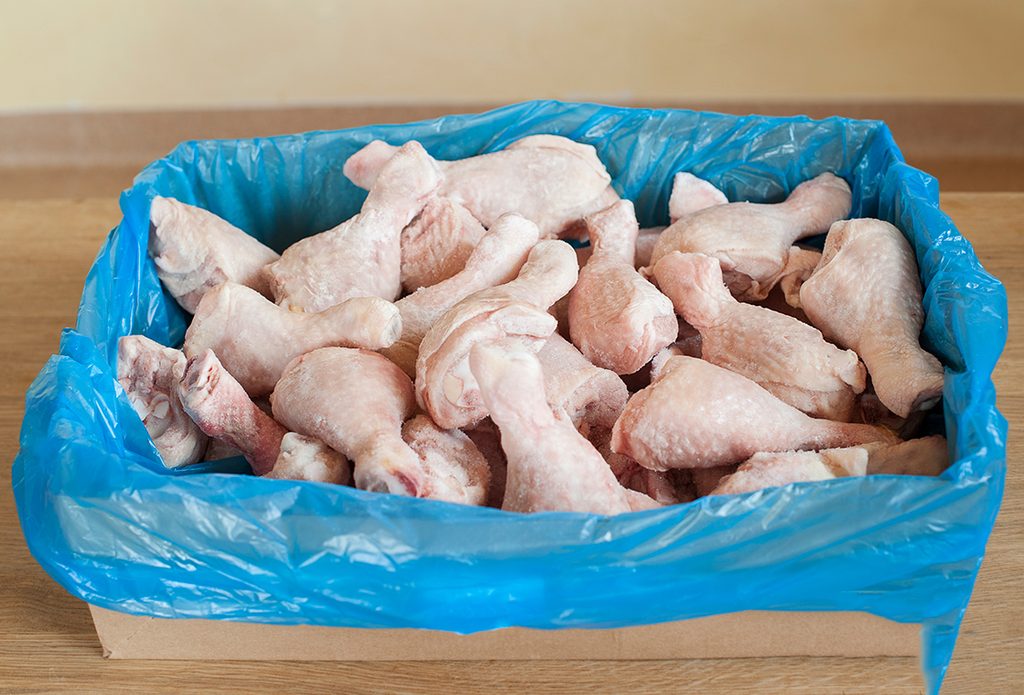
Frozen Chicken Feet Packaging
Packaging is an important part of international poultry trading.
The buyer should confirm:
- Carton dimensions
- Net weight
- Gross weight
- Pieces per carton, if applicable
- Cartons per pallet
- Pallets per container
- Carton labeling
- Production date
- Batch identification
- Storage instructions
The exact configuration can vary according to supplier, destination market and buyer requirements.
Do not assume that every Brazilian supplier uses the same carton size or loading configuration.
Frozen Chicken Paws and Feet Storage
Frozen chicken products require appropriate temperature-controlled storage.
Importers should consider the complete cold chain from the processing facility through transportation and into the destination warehouse.
This includes:
- Factory cold storage
- Reefer container loading
- Port storage
- Ocean transportation
- Destination port handling
- Customs clearance
- Cold storage
- Final delivery
A break in the cold chain can negatively affect product quality.
For this reason, importers should work with experienced cold-chain logistics providers and verify the supplier’s recommended storage requirements before purchase.
How to Buy Brazilian Chicken Feet for China, Hong Kong and South Korea
The purchasing process can be divided into several stages.
1. Define Your Product
First determine whether you need:
- Chicken feet
- Chicken paws
- A specific grade
- A particular weight range
- Processed or unprocessed product
- Specific packaging
2. Find Brazilian Suppliers
Look for exporters, processors and agricultural companies with experience supplying international markets.
Coopavel Cooperativa Agroindustrial provides a range of frozen poultry products that international buyers can investigate.
Visit the Coopavel Cooperativa Agroindustrial homepage.
3. Request a Product Specification
Ask for the complete specification before negotiating price.
4. Request a Commercial Quotation
The quotation should clearly state:
- Product
- Quantity
- Price
- Currency
- Incoterm
- Packaging
- Port
- Validity period
5. Verify Export and Import Requirements
The Brazilian supplier and destination-country importer should establish the applicable requirements before the shipment is booked.
6. Confirm Documentation
The buyer should establish which documents will accompany the shipment.
7. Arrange Shipping
After the order is confirmed, the supplier and logistics company can arrange the reefer shipment.
Wholesale Chicken Feet Suppliers: What Should Buyers Look For?
Choosing a wholesale chicken feet supplier requires more than comparing prices.
A reliable supplier should ideally provide:
Consistent Product Quality
The product should match the agreed specification from shipment to shipment.
Transparent Specifications
Buyers should receive clear information about grade, weight and packaging.
Export Experience
Experience with international poultry trade can simplify communication and documentation.
Production Capacity
Large distributors need suppliers capable of supporting repeat orders.
Cold-Chain Capability
Frozen poultry must be managed throughout a temperature-controlled logistics chain.
Responsive Communication
A supplier should answer questions about specifications, documentation and shipment schedules promptly.
Commercial Flexibility
Depending on the buyer’s needs, the supplier may need to discuss different quantities, packaging configurations and delivery arrangements.
Brazil Frozen Chicken Feet Export Guide for Global Buyers
Brazilian chicken feet can be attractive for buyers beyond China, Hong Kong and South Korea.
Potential markets can include:
- Southeast Asia
- East Asia
- Africa
- Middle East
- Latin America
- Caribbean
- Selected European markets
However, import regulations vary significantly between countries.
Therefore, a supplier’s eligibility for one destination does not automatically mean the same product can be shipped to every country.
Importers should always confirm the requirements for their own destination.
Other Frozen Chicken Products From Brazil
One advantage of working with a supplier offering multiple poultry products is the possibility of consolidating sourcing requirements.
For example, an importer that purchases chicken feet may also need breast meat, drumsticks or wings.
Coopavel’s product range includes several frozen poultry categories.
Frozen Chicken Breast
Chicken breast is one of the most widely traded poultry cuts internationally and can be used by retailers, restaurants, food processors and foodservice distributors.
See Frozen Chicken Breast for more information.
Frozen Chicken Drumstick
Chicken drumsticks are popular across retail and foodservice markets and can be purchased by importers looking to diversify their poultry portfolio.
Explore Frozen Chicken Drumstick.
Frozen Chicken 2-Joint Wing
Two-joint wings can be suitable for restaurants, foodservice distributors and wholesale poultry buyers.
See the Frozen Chicken 2-Joint Wing product page.
Frozen Chicken 3-Joint Wing
Three-joint wings offer another option for international poultry buyers and foodservice markets.
View Frozen Chicken 3-Joint Wing.
Frozen Chicken Feet
For buyers specifically looking for Brazilian chicken feet, see Frozen Chicken Feet.
Frozen Chicken Paws
Importers looking for chicken paws can explore the Frozen Chicken Paws product range.
Chicken Feet vs Chicken Paws: What Should Importers Ask?
The terminology question becomes particularly important when negotiating international orders.
A professional buyer should ask the supplier to answer the following:
Are chicken feet and chicken paws the same product under your specification?
Then ask:
- What exact part is included?
- Are nails removed?
- Is the product cleaned?
- Is the yellow skin retained?
- What grade is available?
- What is the average size?
- What is the weight range?
- What is the carton weight?
- What is the freezing method?
- What is the shelf life?
- What is the storage temperature?
- What documents are supplied?
- Which destinations can the product be exported to?
These questions eliminate ambiguity.
How to Compare Brazilian Chicken Feet Suppliers
A useful supplier comparison table should include more than price.
| Supplier Factor | Why It Matters |
|---|---|
| Product specification | Confirms exactly what you are buying |
| Grade | Helps compare quality |
| Weight range | Important for customer requirements |
| Packaging | Influences logistics |
| MOQ | Determines purchasing feasibility |
| Production capacity | Important for repeat orders |
| Export experience | Can simplify international transactions |
| Documentation | Essential for import clearance |
| Cold-chain logistics | Protects frozen product quality |
| Price | Determines commercial competitiveness |
| Lead time | Helps plan inventory |
| Payment terms | Affects cash flow |
A low price is not necessarily the best deal if the product specification does not match the buyer’s market.
Brazilian Chicken Feet Price: What Determines Wholesale Cost?
There is no single universal wholesale price for Brazilian chicken feet.
Prices can change according to:
- Product grade
- Product size
- Processing requirements
- Order quantity
- Packaging
- Brazilian market conditions
- Exchange rates
- Freight rates
- Port charges
- Destination
- Season
- Availability
- Incoterms
For this reason, buyers should request a current quotation based on their exact purchasing requirements.
For large-volume orders, the supplier may quote on an FOB, CIF or another agreed basis.
Bulk Orders for China, Hong Kong and South Korea
A serious importer should provide enough information for the supplier to prepare an accurate quotation.
A useful RFQ can include:
Product: Frozen chicken feet/paws
Origin: Brazil
Destination: China / Hong Kong / South Korea
Quantity: Number of cartons or containers
Packaging: Required carton specification
Grade: Required grade
Incoterm: FOB / CIF / other
Port: Preferred destination port
Required documentation: Destination-market requirements
Target delivery: Preferred shipment period
This is much more effective than simply sending a message asking, “Chicken paws price?”
Why Long-Term Supply Relationships Matter
For wholesalers and distributors, consistency is often more valuable than obtaining the cheapest one-time shipment.
A long-term Brazilian poultry supplier can potentially help the buyer develop:
- Consistent specifications
- Repeat shipment schedules
- Stable packaging
- Better demand planning
- Improved communication
- More predictable supply
Before entering a long-term agreement, however, buyers should conduct appropriate supplier due diligence.
Questions to Ask Before Buying Brazilian Chicken Feet
Are Brazilian chicken feet and chicken paws the same?
They can refer to the same general poultry part in commercial usage, but terminology varies. Always request the supplier’s exact product specification.
Are Brazilian chicken feet suitable for Chinese buyers?
Brazilian frozen poultry can be commercially attractive to Chinese buyers, but import eligibility and applicable requirements must be confirmed for the specific establishment and product.
Can I buy chicken paws wholesale from Brazil?
Yes, international buyers can approach Brazilian poultry exporters and request bulk quotations subject to product availability and destination-market requirements.
Can I import Brazilian chicken feet into Hong Kong?
Potentially, subject to the applicable Hong Kong import, food-safety, veterinary and customs requirements.
Can I import Brazilian chicken feet into South Korea?
Potentially, subject to South Korean import regulations and the eligibility of the relevant Brazilian establishment and product.
What is the best way to compare chicken feet suppliers?
Compare product specification, grade, weight, packaging, documentation, supplier capacity, shipping terms and total landed cost—not price alone.
Can I buy chicken feet together with other Brazilian poultry products?
Depending on supplier availability and market eligibility, buyers may source chicken feet together with products such as breast, drumsticks and wings.
Final Guide for Buyers
So, what is the difference between Brazilian chicken feet and chicken paws?
In international poultry trading, the terms can overlap considerably. The most important difference is often not the English terminology but the specific commercial specification offered by the supplier.
For this reason, importers in China, Hong Kong, South Korea and other international markets should avoid making purchasing decisions based solely on the product name.
Instead, confirm:
- Exact product definition
- Processing
- Cleaning
- Grade
- Weight
- Packaging
- Freezing
- Storage
- Shelf life
- Origin
- Export establishment
- Documentation
- Destination eligibility
- Shipping terms
Brazil remains an important origin for international poultry sourcing, and frozen chicken feet and paws can provide opportunities for wholesalers, distributors, restaurants and foodservice businesses serving Asian and global markets.
For buyers interested in sourcing Brazilian frozen chicken products, Coopavel Cooperativa Agroindustrial offers a broader poultry product range for investigation.
Explore the individual products:
- Frozen Chicken Feet
- Frozen Chicken Paws
- Frozen Chicken Breast
- Frozen Chicken Drumstick
- Frozen Chicken 2-Joint Wing
- Frozen Chicken 3-Joint Wing
For China, Hong Kong and South Korea buyers, the strongest sourcing strategy is to define the exact product specification first, verify destination-market requirements, compare Brazilian suppliers and then negotiate bulk pricing based on the actual shipment requirements.
Whether the buyer is searching for Brazil frozen chicken feet, wholesale chicken paws, Brazilian chicken feet suppliers, frozen chicken paws for China, chicken feet for Hong Kong or bulk chicken feet for South Korea, a detailed product specification and professional supplier verification process can make international poultry purchasing significantly more efficient.